
Hembrug, 2019
NO CAMOUFLAGE – exhibition at HET HEM
November 21 – December 19
For more than half a century, the Shock Forest acted as a sonic and visual camouflage for the military factories inside the Hembrug terrain. Today, a different kind of camouflage is present. As people wander through these impressive spaces, the difficult history of the factory is camouflaged by the promise of ‘art’ and entertainment.
On September 11 of this year, the Shock Forest Group began its research inside the ruins of the Eurometaal 0.50 Bullet Factory (now called Het HEM). As Anna Tsing writes, ‘in a global state of precarity, we don’t have a choice other than looking for life in these ruins.’ We have asked questions about collaborative survival, about how to find life in a damaged place, which is both ‘an act of desperation and faith.’ We have committed ourselves to the search for traces of violence and injustice as well as for reflections of transformation and love. No Camouflage is seeing what is as an extension of what was: infinite responsibility, radical presence.
A Monument to What?
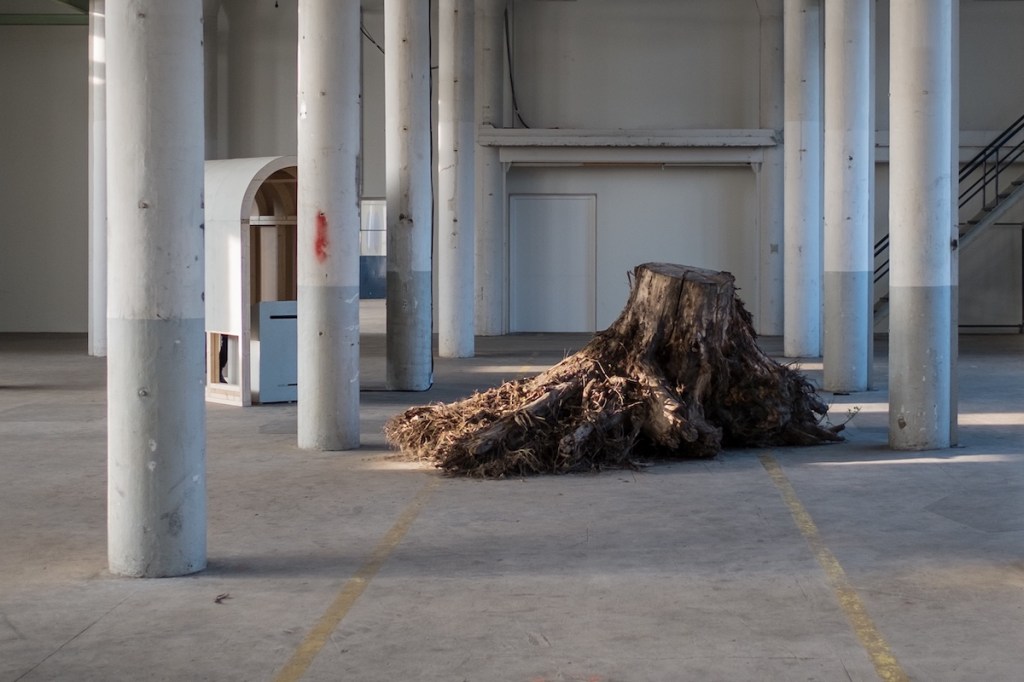
Over the last 16 years, the soil of the Shock Forest has been overturned in the search for buried ammunition, traces of cyanide, and other weapons or toxins. The two trees in view, which originally had ‘monument status’ were the last to be cut down after unexploded munitions were found in the soil under their roots. They will soon be replaced by two trees of the exact same species which will in turn gain monumental status. What are the new trees a monument to? What are these old, discarded trees now that they are no longer protected by our legal status? What were they monuments to in the first place? If these trees tell a story about our shared pasts, what might they say about our shared futures?
Infinite Responsibility
During our early days of research within this building, we noticed how light fell on the water of the Noordzeekanaal and reflected onto the ceiling of the factory, trembling with warped undulations. From the large windows of the former factory we started noticing the ships passing through. We saw how each ship carried a different name and different cargo. We began listing these names. The list turned into a collectively assembled photographic archive.
We don’t know what is hidden in the belly of these ships, but the water carries them. Where did bullets land on the other side of the water? In the past two months of investigation, we have followed the bullets to their end points. These ‘movements’ appear as messages in the back of the postcards. What is behind this movement? What’s behind these names? Expedition, Stranger, Conquest, For-Ever… The echoes from the past are still hiding. In blurring the past and present, we see the here as there and the there as here,
always here, wherever one is and wherever one looks, closest to home. Infinite responsibility therefore, no rest allowed for any form of good conscience. (Derrida, Dedication to Chris Hani, Specters of Marx)
From all parts of the world Zaan-industries obtain their raw materials and their products are to be found all over the world. The all-connecting element is water. The prosperity of the Zaan-area will continue to grow so long as industry, trade, and shipping are prepared to see each other as the equally strong links of a solid chain. (Artillerie Inrichtingen sales pamphlet, ca. 1965)
No Camouflage: Archive
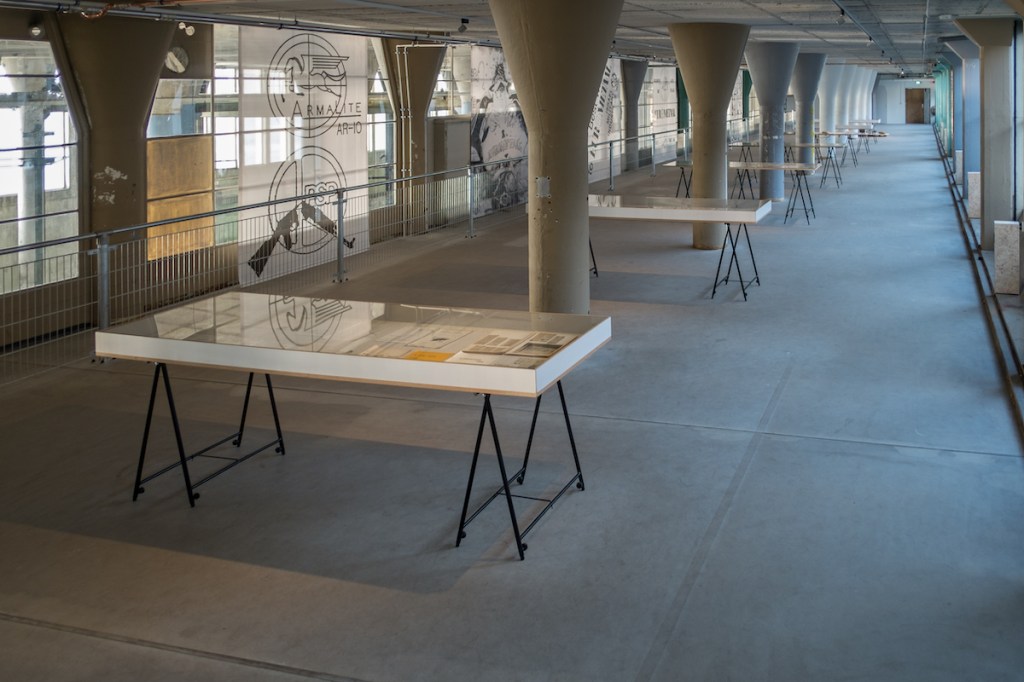
The Zaan region has always been a place for production. Industry shaped forests and waterways to maximize efficiency and profit. Industry grew from the hard labor of people who found a home in the Zaanstreek. This area, previously known as the Red Zaan, has always been a place where workers and activists united and fought for their rights. Through found documents and the Shock Forest trees’ own stories, we seek to understand the many sides of a complex history.
This archive was compiled in collaboration with Erik Schaap and the Zaanstad Archive. Erik Schaap (1961) is a journalist and writer based in Zaandam. Beginning in the eighties, he has taken a stand against the arms industry by writing for local publications and through direct actions, with a particular focus on the Eurometaal company.
The products that rolled out of this factory of death varied from mustard gas to mines and from guns to grenades. Faulty material accidentally led to fatalities in the Netherlands. The merchandise that did function properly created thousands of victims worldwide…Despite the lovely appearance in 2019; you will not easily find a more guilty landscape than the terrain where you are now in the Zaan region. (Erik Schaap, Nov. 2019)
Radical Presence
In 1902, the Shock Forest was mapped out according to a detailed planting scheme. During its functioning days, the aim was to test weapons, to program death. The logic of the function dominated the landscape, obstructing organic assemblages and natural extensions. Since the forest closed and the military moved on, neighbors have wished to walk among the trees and abandoned buildings. Children have peered over the plant-covered fences wondering what mysteries lay inside. We retraced the shape of the Shock Forest, with the intent of re-mapping it through a web of healing sounds and frequencies. This was then combined with field recordings from the forest, placed in the areas where the recordings were taken. The forest liberates itself from strict categorizations through its vibratory tranquillity, its radical presence. How can we let the forest take over our structures, erode them from within, in order to create a common ground?
Shock Forest Score
Each year Eurometaal workers celebrated the anniversary of the company’s founding on November 22, 1697 with a song. Since Eurometaal closed in 2003, the only song that remains is that of the canal’s waves, caused by the cargo ships and the continuation of overseas shipments. On the 22th of November this year, we have set out to reclaim this day by recording a protest-song made of the movements of waves.
Shock Forest Group
Katya Abazajian
Sheryn Akiki
Pantxo Bertin
Axel Coumans
Paula Dooren
Susanna Gonzo
Nicolás Jaar
Pamela Jordan
Daria Kiseleva
Jelger Kroese
Erica Moukarzel
Simon Skatka Lindell
Sjoerd Smit
Bert Spaan
The Shock Forest Group would like to give special thanks to:
Jeanne Bonnier
Anna Carlgren
Rolando Hernandez
Anna Ippolito
Stéphanie Janaina
Patricia Kaersenhout
Brandon Labelle
Adrian Lahoud
Jan Mars
Yeshimabeit Milner
Ash Sarkar
Erik Schaap
Milan van Teunissen
Juha van ‘t Zelfde
Marzio Zorio
Sjaft
Leeman’s Speciaalwerken
Zaanstad Archive
And our gratitude to the Het Hem team.
images by Annie Ruffin.
 Axel Coumans